

The Discover Portugal blog contains affiliate links. If you make a purchase using one of these links, we may receive compensation at no extra cost to you. See the Disclaimer for more information.
Beautiful Cabo da Roca Portugal; most westernmost point of Europe

Cabo the Roca, Portugal, is one of the most visited places near Lisbon. Cape Roca is the most westerly point in the country, and also that of mainland Europe. It’s a great place to visit from Lisbon, Cascais or Sintra, and you can reach it by public transport, car and even a taxi. Many Sintra day tours combine visiting a palace with seeing the famous cliffs.
We love one of the beaches near Cabo da Roca and regularly visit the cape to hike. The landscape is stunning here, and if you have time, I highly recommend some of the trails. Let’s take a closer look at all the sights you can find here and see if a trip to Cabo da Roca is worth it.
Discover Cabo da Roca
Not sure where to go in Portugal?
Take the free Portugal travel quiz and find the destination that best matches your travel style. You’ll get your result plus practical tips to help you start planning your trip.
What is Cabo da Roca Portugal?
Cabo da Roca, Portugal, is the most western point of the country and continental Europe. The cape is near Lisbon, and it’s a popular spot to visit. Cape Roca is a whopping 140 meters (460 ft) high, providing excellent views over the Atlantic Ocean.
It was once known as Promontorium Magnum by the Romans, and it was often referred to as the Rock of Lisbon during the Age of Sail between the mid-16th and mid-19th centuries. Cabo da Roca is located within the Sintra-Cascais Natural Park, just west of Lisbon city centre.
Cabo da Roca Portugal things to do
Cabo da Roca Lighthouse
Aside from stunning cliffs, there isn’t much to see at Cabo da Roca. But one building stands out: a beacon of light has dominated Cabo da Roca since 1772 to protect ships. It was the first lighthouse of many to come.
Cabo da Roca Lighthouse, or Farol do Cabo da Roca, is located 165 meters (541 ft) above sea level, and it was the first new purpose-built lighthouse in Portugal. Previous lighthouses were built on existing platforms or beacons.


The Marquis of Pombal decided in 1758 that six lighthouses be built along the Portuguese coast to assist with navigating ships. Cabo da Roca Lighthouse is the second oldest lighthouse in the country. It is 22 metres tall and surrounded by nine other buildings. Unfortunately, the lighthouse is not open to the public.

The monument
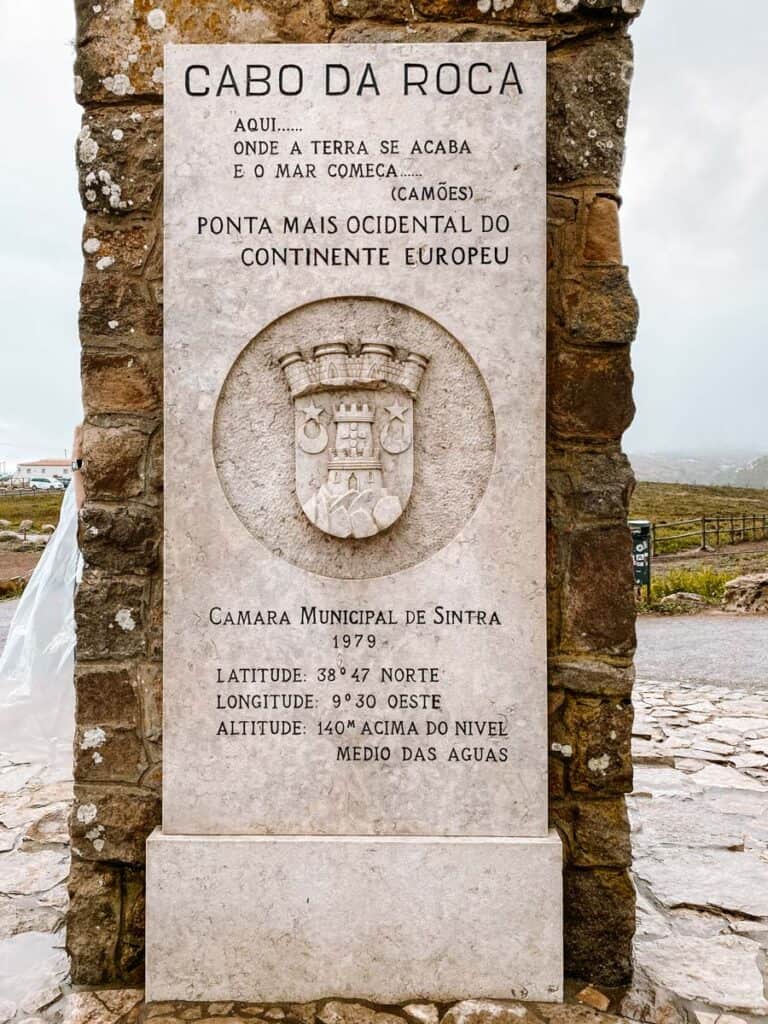
Close to the parking lot and close to the cliffs, you’ll discover another highlight. You’ll find a stone monument with an emblematic cross at the westernmost point of continental Europe. The memorial contains a plaque stating it is indeed the westernmost point of continental Europe, and there is a text as a homage to the Portuguese poet Luís de Camões.

The text reads:
Aqui… (Here)
Onde a terra se acaba (where the land ends)
E o mar comeca (and the sea begins)
At this westerly point, it was believed, up until the 14th century, that the land ends here where the sea begins! You can see wide and far, so it’s no surprise! The plaque also reveals the coordinates and height: latitude 38°47 north, longitude 9°30 east, and altitude 140 meters above sea level.

The gift shop
Aside from the stunning views, the lighthouse and the monument, there is little to see around Cabo da Roca. Most tourists will stay 20 to 30 minutes to enjoy the views. Remember, there can be strong winds along this rocky coast, so be sure to dress warm.
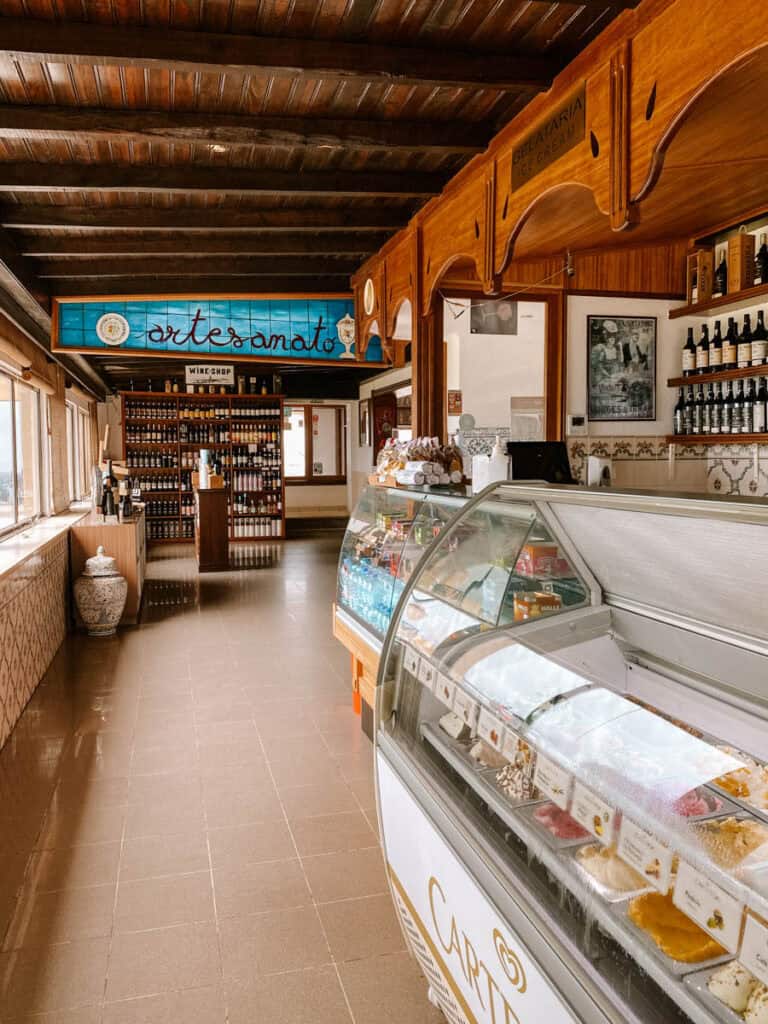
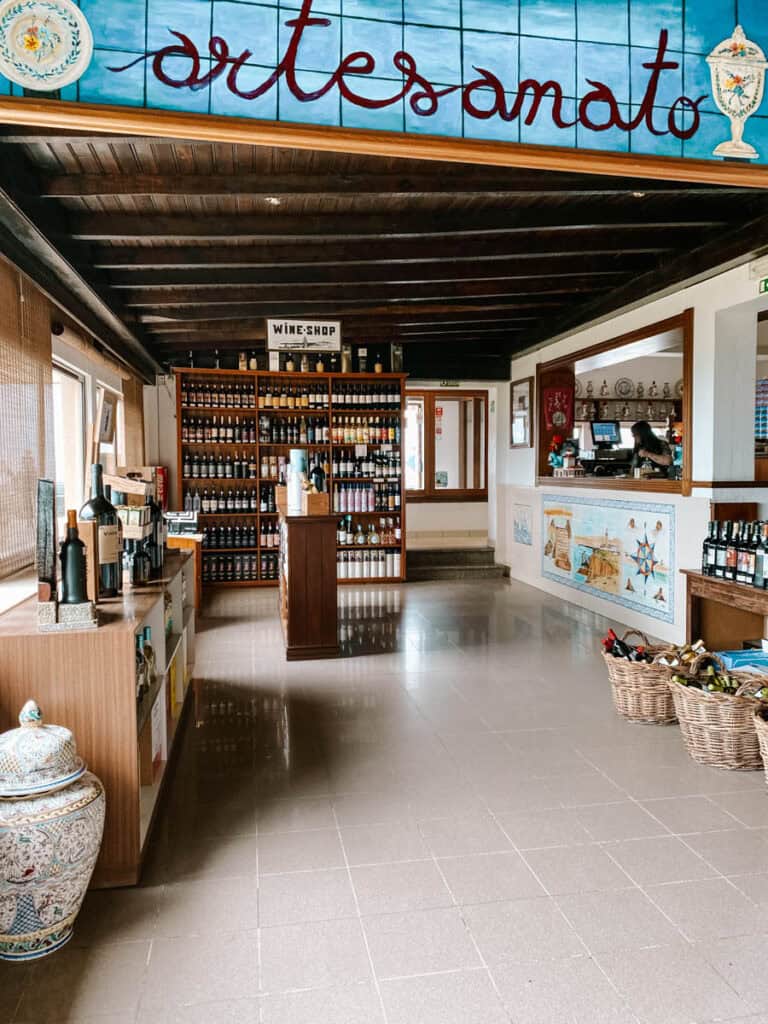
After you visit Cabo da Roca, you can take a look at the gift shop. If you need help deciding what to buy in the souvenir shop, check out this article about the most loved souvenirs from Portugal. They may have something nice to bring home for you.
Cabo da Roca restaurant
If you want to eat something, you can visit the Cabo da Roca restaurant. They offer hot and cold drinks, and snacks such as pastel de nata and croissants. When you buy something to eat or drink, you can also use the washrooms. The view from the restaurant is amazing, too, so it is perfect for a light snack and a drink.
The beaches
The western coast of Portugal has many beautiful beaches, and you’ll find several of them near Cabo da Roca, Portugal. One of the most dramatic is Praia da Ursa or Bear Beach. Ursa Beach is very near, but you’re in for a hike to reach the cliffs.
If you want to visit Ursa Beach, you’ll hike about 40 minutes from the road. The windswept cliffs and rock formations are some of the best in Portugal, and Ursa Beach is well worth a visit! If you like stunning beaches and hidden gems, you should not miss Praia da Ursa. It is one of our favourite beaches in Portugal!


Please note: the trail is very rocky and steep in places. You don’t need to be an athlete, but a certain fitness level will be helpful. The same goes for Praia da Aroeira, which you can only reach after a cliff walk.
You find Praia da Aroeira between Cabo da Roca and Praia da Ursa. Further south, you can see Praia de Assentiz and Praia do Louriçal, two small beaches hidden between the rocks. You can see both beaches from the top of Mirador Sul do Cabo da Roca.
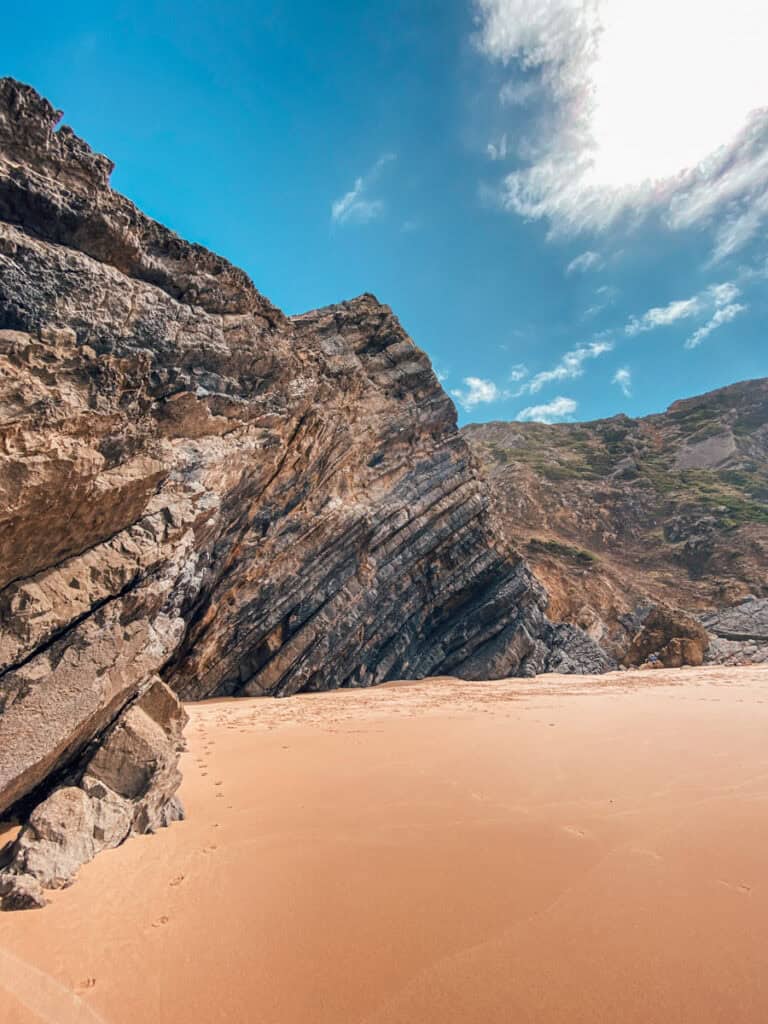

There are some more accessible sandy beaches nearby as well. Take, for example, Praia da Adraga, which you can easily reach by car. Praia da Adraga is a 15-minute drive from Cabo da Roca, and this beach has some stunning stock formations to the left-hand side as well.
Or visit Praia Grande do Rodízio, a beach that families much love. This beach also has excellent facilities and restaurants nearby. The Sintra beaches are some of our favourite places to visit in summer, and we often holiday here for a few nights.

Cabo da Roca hiking trails
As you can tell from reaching these incredible beaches, some fantastic hiking trails are along the Portuguese coast. So before you hit the road back to Lisbon, it’s a fabulous idea to discover the hikes at the most westerly point of Europe.


Many trails follow the cliffs, and you’ll enjoy spectacular views of the Atlantic Ocean. Hiking north will be your best bet. Praia da Ursa is around 1 kilometre to walk, and you’ll reach Praia da Adraga within 2 kilometres from Cabo da Roca.
🥾 Tip: Join a hiking tour including transfers!
The hike towards Praia de Assentiz (south) is around 800 meters, and Praia de Louriçal is 1 kilometre away. These two hidden beaches are not openly accessible to reach by foot.


Sintra-Cascais Natural Park offers many more incredible nature trails through the woods and mountains. So, after a stunning coastal walk, head over to Sintra and discover the fairytale-like landscape!
Hiking tip!
We use the AllTrails app for all our hikes in Portugal and the rest of the world. You can use the offline maps, and the app will alert you if you’re taking a wrong turn. On top of that, you’ll read detailed information about the hike you wish to follow and find plenty of tips.
Flora at Cabo da Roca Portugal
Plant life is also pretty amazing along Cabo da Roca, and especially during a hike, you can see some stunning plants along the way. One of the most common plants is the Hottentot fig or Carpobrotus Edulis. It’s a ground plant with succulent leaves and beautiful yellow flowers. Besides Hottentot-fig, it’s also named ice plant or sour fig.


How to reach Cabo the Roca?
Cabo da Roca is a well-visited site in Portugal, so let’s take a look at how you can reach the cape from Lisbon, Cascais, and Sintra.
Driving to Cabo da Roca
The easiest way to reach Cabo da Roca is by car. It takes around 1 hour to drive from Lisbon, and from Sintra Town and Cascais, the journey takes just under 30 minutes. Cabo da Roca is located close to the village of Azóia, and there are many places to see in this area. Take a day trip to the coastal town Praia das Maçãs or marvel at the views at Azenhas do Mar.
Renting a car is an excellent idea to discover more places along the Sintra coastline. Rentals are widely available in Lisbon or at the airport. Check this post for information about your rental car in Portugal, or check the best deals with DiscoverCars below. A large parking lot at Cabo da Roca has plenty of space for buses and cars.

Take the bus to Cabo da Roca
Many tourists make a day trip to Cabo da Roca by public transportation. Two bus services are available, one from Sintra and one from Cascais. The Cabo da Roca bus line is 1624 that travels between Sintra and Cascais. For the current timetable, check the Carris Metropolitana website.
Usually, the bus is available between 9.40 AM and 7.40 PM. In winter and during holidays, there will be other times available.
From Cascais, it takes just over 30 to 40 minutes, and to Sintra Town, around 40 minutes to one hour. The bus station in Cascais is just outside the train station.
Sintra Cabo da Roca bus
If you stay in Sintra, you can also take bus line 1253, the Sintra Circular Line. This line operates more frequently and starts just outside Sintra train station. Click here to see the current timetable on the Carris Metropolitana site.
This bus is available from 6:30 AM until 8 PM (depending on the season, so be sure to double-check this).
By taxi
If you’re in Lisbon, you can take a train to Sintra Town or Cascais. After your train journey, you can take a bus to the most westerly point. There is also the option to take a taxi if needed. Try Bolt or Uber for competitive prices, or take a regular taxi instead of public transport.
From Sintra to Cabo da Roca it will. cost you somewhere between € 15,00 to € 30,00. From Cascais, the journey usually costs from € 15,00 upwards.
With an organised tour to Cabo da Roca
Cabo da Roca is one of the most famous day trips from Lisbon. Tours often combine a visit to Pena Palace or Quinta da Regaleira with visits to Cabo da Roca and Cascais. So you’ll get to see 3 or 4 sights at no extra cost.
All you need to do is sit back and relax, and during many tours, your guide will provide you with a lot of information about Sintra and the palaces. A day trip is popular, so be sure to book on time. Above, you’ll discover some fabulous options. Or check some of the below options:
Things to do near Cabo the Roca
Aside from the lighthouse and the cliffs, you can visit a few more places nearby. Make a trip to the Convent of the Capuchos, for example, a hidden gem in the Sintra forests. It’s also known as the Convent of Cork, as its structure is totally made of natural materials, including cork. The parish of Colares is another hidden gem. From here, you can easily reach Praia das Maçãs, Praia da Ursa, and Azenhas do Mar.


Sintra Town is busier, but there are many beautiful sights, from famous palaces such as Palácio Nacional da Pena to stunning sites such as Quinta da Regaleira.
Other must-see attractions are Biester Palace, the Moorish Castle, Sintra National Palace, and Park and Palace of Monserrate. You can combine a few of these places on a day trip from the bustling city of Lisbon, but staying in the area is a holiday in itself!


Staying overnight in the area of Cabo the Roca
There is little around Cabo da Roca, but the area is an excellent location for a holiday outside Lisbon! The nearby village Colares is fabulous, but Praia das Maçãs (Apple Beach) and Sintra Town are popular destinations.
Examples are the luxurious Valverde Sintra Palácio de Seteais and the Penha Longa Resort. Adraga Patio House is great for families, and when you travel on a budget, Lanui Guest House is fabulous. Check out the hotels below and book your dream destination for your trip to Portugal.
Not sure where to go in Portugal?
Take the free Portugal travel quiz and find the destination that best matches your travel style. You’ll get your result plus practical tips to help you start planning your trip.
FAQ
Is Cabo da Roca worth visiting?
Cabo da Roca is a great place to visit in combination with some nearby sights. You can join a day trip from Lisbon, take public transport, take a taxi or drive the Cabo da Roca. There are lovely towns nearby as well as mesmerising beaches.
What is Cabo da Roca famous for?
Cabo da Roca is the most western point of continental Europe. You can also find one of the oldest Portuguese lighthouses here.
How do I get from Lisbon to Cabo da Roca?
From Lisbon to Cabo da Roca is most accessible by car or taxi. You can also take a train to Sintra or Cascais and continue your journey by bus. Many tour operators offer excursions to Cabo da Roca as well.
Final thoughts
Cabo da Roca is the most westerly point in Portugal, continental Europe and even the Eurasian landmass. At this location, you can find a lighthouse and a monument. Stunning cliffs and beaches surround the area. That makes it an excellent destination for hikes to, for example, Praia da Ursa. Ursa Beach is only a short but challenging walk from here. You can reach Cabo da Roca by car, taxi, and public transport.
You can also join an organised tour to Cabo da Roca if you prefer. Cabo a Roca is very popular amongst tourists, but you can easily escape the busier areas after a short walk. Be mindful that the weather can change quickly here, and bring extra clothes if needed.
Are you curious to visit more capes in Portugal? Check out Cabo Espichel, where you can even find ancient dinosaur footprints! This cape is much quieter but incredible, too!

More things to do in Sintra
- How to get to Palácio da Pena in Sintra
- Quinta da Regaleira in Sintra, a guide to visit this magical UNESCO site
- Complete Guide to Park and Palace of Monserrate Sintra
- Sintra day trips from Lisbon; discover the best excursions
- The hidden gem in Sintra; Discover the ancient Convent of the Capuchos
- Beautiful Cabo da Roca Portugal; most westernmost point of Europe
- Biester Palace, a beautiful hidden gem in Sintra
- Sintra National Palace: Discover the beautiful palace close to Lisbon
- Lisbon Sintra by train Travel Guide + 8 top sights to visit
- Discover the picturesque coastal town Azenhas do Mar near Sintra
- Visit the beautiful Castle of the Moors (Castelo dos Mouros) in Sintra
- 8 irresistible beaches in Sintra to visit during your holiday
- How to get to stunning Praia da Ursa
- Beautiful Queluz National Palace, a hidden gem in Sintra
Pin to read later